 Chat with Sales & Support

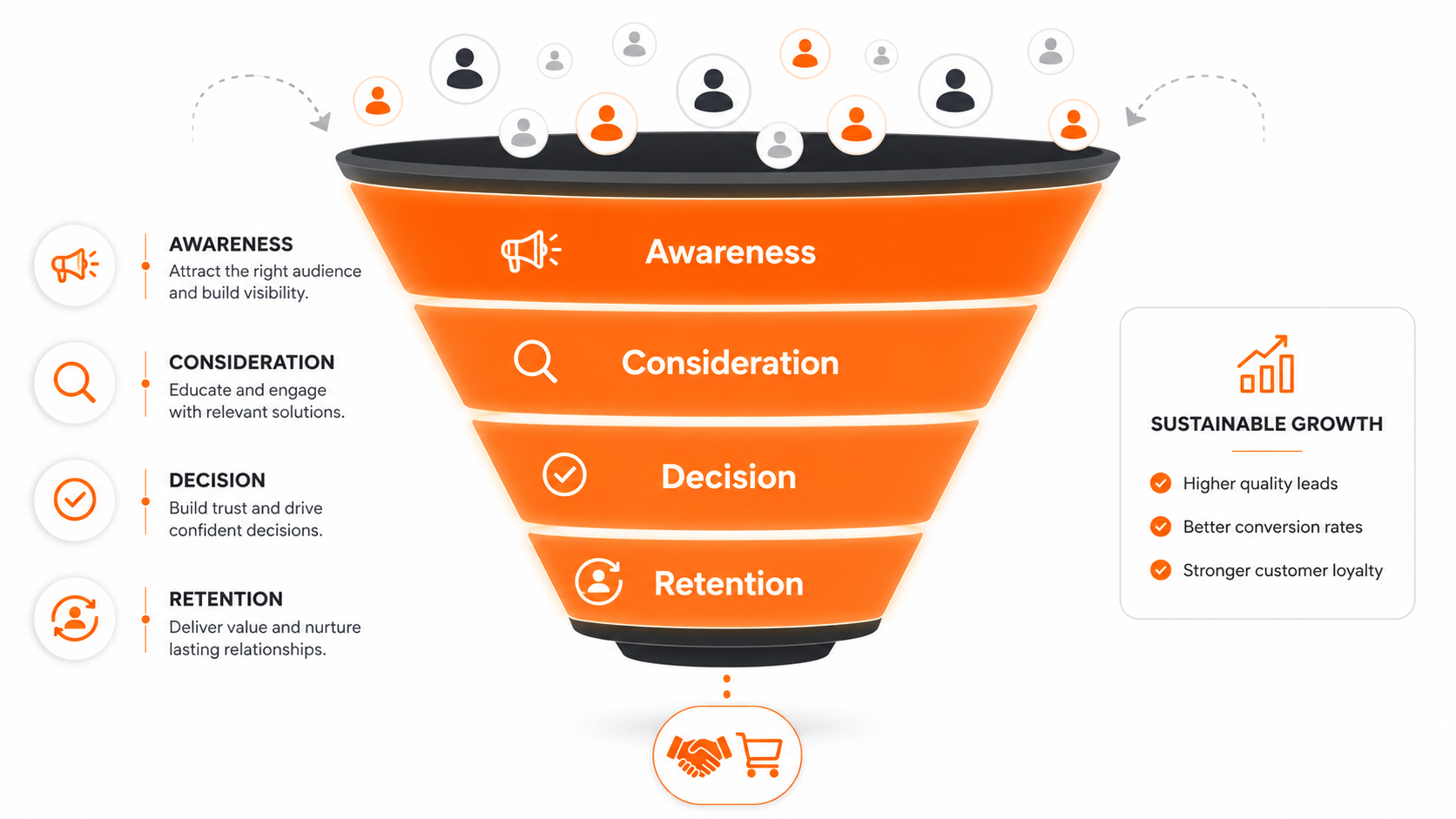

Digital Marketing Funnel: The Complete 2026 Framework to Turn Clicks Into Customers
You’re spending money on ads. Traffic is coming in. And yet the sales just aren’t landing the way the numbers said they should. Sound familiar?
The gap is almost never the traffic. It’s the digital marketing funnel sitting between that first click and the moment someone actually pays you. Most businesses pour budget into the top, then watch leads quietly leak out the sides because there’s no system guiding people from “who are you?” to “take my money.”
Here’s what this guide gives you: the complete 2026 funnel framework — every stage, the real conversion benchmarks to aim for, a step-by-step build, the mistakes that drain budgets, and a worked example with ₹ and $ numbers. Whether you’re running a D2C brand in Kolkata or a home-services company in the US, the same architecture applies.
We build these funnels for clients every week, so this isn’t theory. It’s how we’d set yours up.
What you’ll learn
- What a digital marketing funnel actually is (and what’s changed for 2026)
- The 4 stages — TOFU, MOFU, BOFU, and the loop most people forget
- Marketing funnel vs sales funnel, and where the money really leaks
- A practical 8-step build you can start this week
- Realistic conversion benchmarks per stage
- The most common funnel mistakes and myths
- A mini case study showing how optimisation doubles revenue on the same traffic
- A copy-paste FAQ + schema for AI search
What is a digital marketing funnel?
A digital marketing funnel is the structured path a prospect follows from first discovering your brand to becoming a paying — and ideally repeat — customer. It maps the customer journey into clear stages and assigns the right content, channel, and offer to each one, so people keep moving forward instead of dropping off.
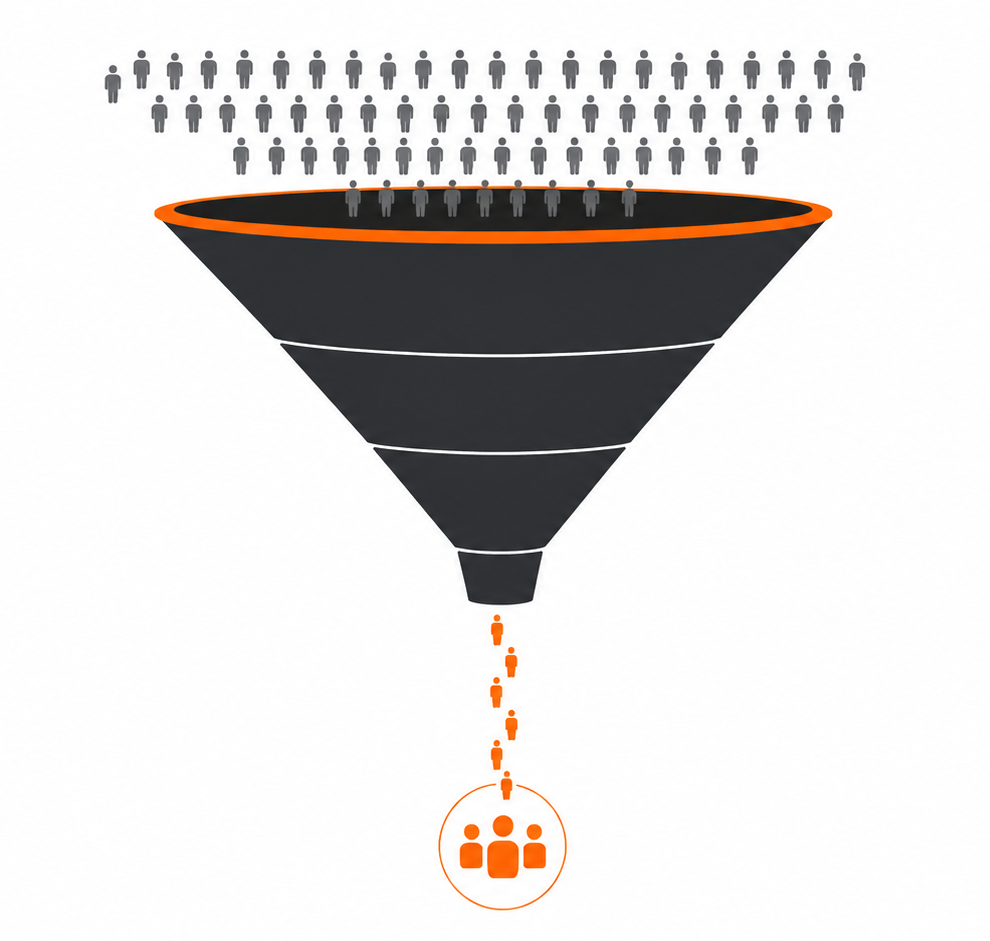
Picture a literal funnel. A lot of strangers go in at the wide top. Fewer become interested. Fewer still buy. The job of the funnel isn’t to magically keep everyone — it’s to make sure the right people slide smoothly down to the bottom, and that you stop losing the ones who were ready to convert.
The classic mental model behind it is AIDA — Attention, Interest, Desire, Action — a marketing principle that’s been around for over a century (Wikipedia). The 2026 version is the same backbone, just rebuilt for how people actually buy now: across mobile, messaging apps, search, social, and increasingly AI assistants.
What’s different in 2026
The biggest shift? The funnel isn’t a straight line anymore.
People bounce between stages. They discover you on Instagram, ignore you, see a retargeting ad three weeks later, ask ChatGPT for a comparison, read two reviews, then DM you on WhatsApp. The stages are still real — but the journey is messy and non-linear, which is why a strong marketing funnel automation system matters more than ever. It catches people wherever they re-enter.
The 4 stages of a marketing funnel (the 2026 framework)
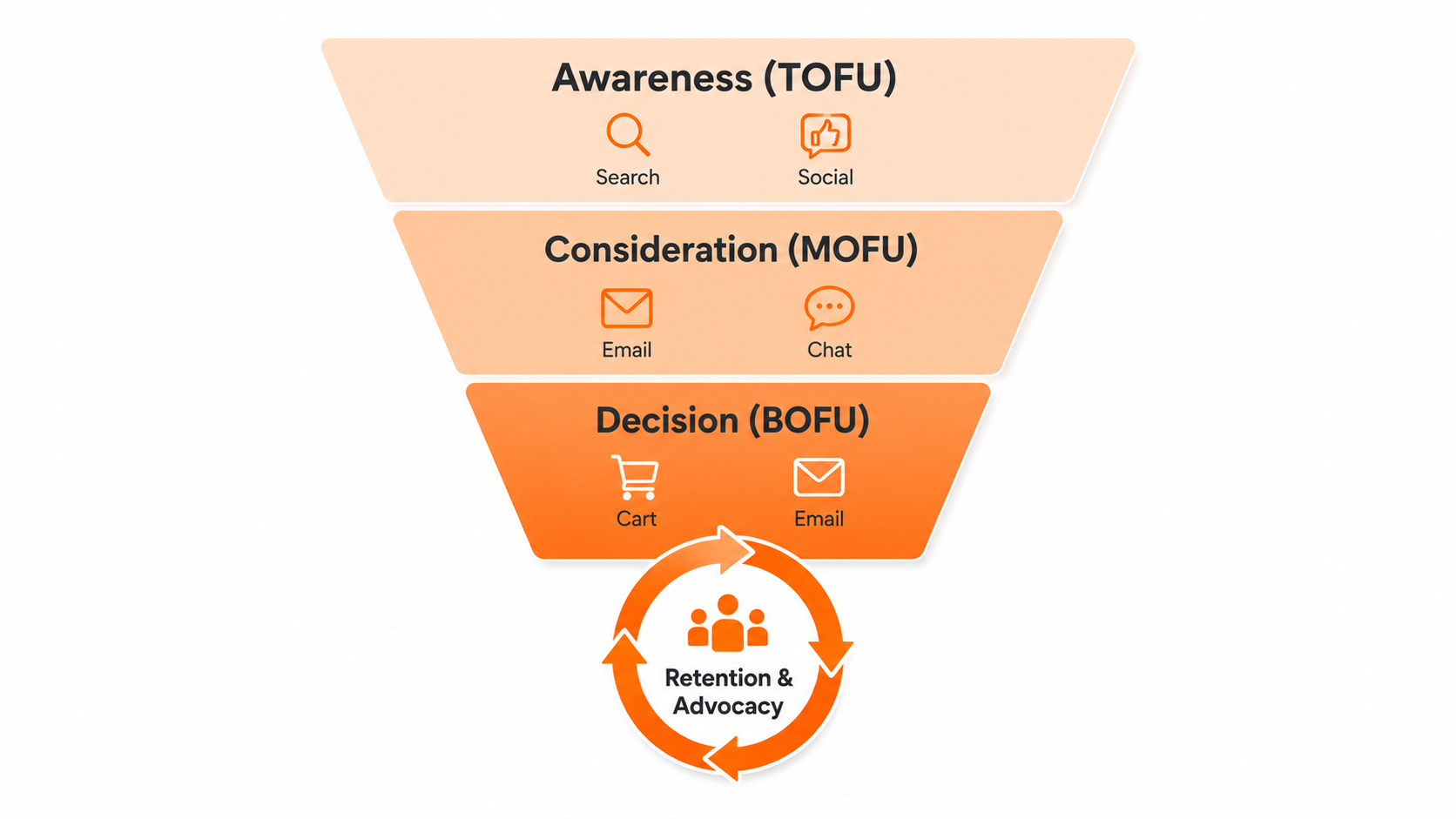
A marketing funnel has four working stages. The first three are commonly shortened to TOFU, MOFU, and BOFU — top, middle, and bottom of funnel — and the fourth is the post-purchase loop that turns one sale into many.
Front-loading the answer: here’s the full picture, then we’ll break each one down.
1. Awareness (Top of Funnel — TOFU)
This is discovery. The person has a problem but doesn’t know you exist yet. They’re not ready to buy — they’re looking for answers.
- Their mindset: “I have a problem / question.”
- Your goal: Get found and earn attention.
- Best content: Blog posts, reels, YouTube videos, infographics, how-to guides, podcasts.
- Best channels: SEO, organic social, YouTube, and broad-reach paid campaigns through PPC advertising.
- Metrics: Reach, impressions, traffic, new users, video views.
The mistake here is selling too hard. Nobody wants a pricing page when they Googled “why is my AC not cooling.” Educate first.
2. Consideration (Middle of Funnel — MOFU)
Now they know you, and they’re weighing options — you versus three competitors and the “do nothing” option. This is where you capture contact details and nurture.
- Their mindset: “Which solution is best for me?”
- Your goal: Capture the lead and build trust.
- Best content: Lead magnets (checklists, free guides, calculators), comparison posts, case studies, webinars, email/WhatsApp sequences.
- Best channels: Email, WhatsApp, retargeting ads, and a high-converting landing page design to capture the opt-in.
- Metrics: Leads, marketing-qualified leads (MQLs), email open/click rate, cost per lead.
This is the stage most Indian and US businesses skip — and it’s exactly where leads go cold.
3. Decision (Bottom of Funnel — BOFU)
They’re ready to act. Your only job now is to remove friction and make “yes” the easy choice.
- Their mindset: “I’m ready — convince me to choose you.”
- Your goal: Convert the lead into a customer.
- Best content: Demos, free trials, pricing pages, testimonials, strong offers, comparison sheets.
- Best channels: Sales calls, demos, reviews, and friction-free booking via an appointment booking funnel.
- Metrics: Conversion rate, close rate, customer acquisition cost (CAC).
4. Retention & Advocacy (the loop most people forget)
The sale isn’t the finish line — it’s the start of the most profitable part. Keeping a customer costs a fraction of finding a new one, and happy customers refer others.
- Their mindset: “Was this worth it? Should I tell people?”
- Your goal: Repeat purchases, higher lifetime value, referrals.
- Best content: Onboarding, loyalty offers, upsells, review requests, referral programs.
- Best channels: Email/WhatsApp lifecycle flows, loyalty programs, community.
- Metrics: Repeat purchase rate, lifetime value (LTV), referral rate, reviews.
Modern marketers often draw this fourth stage as a flywheel rather than a funnel bottom — because every retained customer feeds new awareness through word of mouth.
Marketing funnel vs sales funnel: where the money leaks
People use these terms interchangeably, but they’re not the same — and the confusion is expensive.
A marketing funnel covers the journey from stranger to lead. Marketing owns it: awareness, traffic, and capturing interest. A sales funnel picks up from there and covers lead to closed deal. Sales (or, for smaller businesses, you) owns it: qualifying, demoing, and closing.
The handoff between them is where revenue quietly disappears. A marketing team generates leads; sales says the leads are junk; nobody nurtures the in-betweeners. Industry benchmarks consistently show the MQL-to-SQL stage as one of the biggest drop-off points in the entire journey, often converting in the 13–26% range (VWO). Fix that one handoff and the whole funnel performs better.
| Marketing Funnel | Sales Funnel | |
|---|---|---|
| Covers | Stranger → Lead | Lead → Customer |
| Owned by | Marketing | Sales (or founder) |
| Focus | Attention + capture | Qualify + close |
| Stages | Awareness, Consideration | Decision, Negotiation, Close |
| Key metrics | Traffic, CPL, MQLs | Close rate, CAC, deal size |
| Tools | SEO, ads, email, content | CRM, demos, proposals |
For most small businesses in India and the US, one person wears both hats. That’s fine — but you still need to think of these as two connected systems, not one blurry blob.
How to build a digital marketing funnel: 8 practical steps
Here’s the build we’d actually run for a client. You can start step one today.
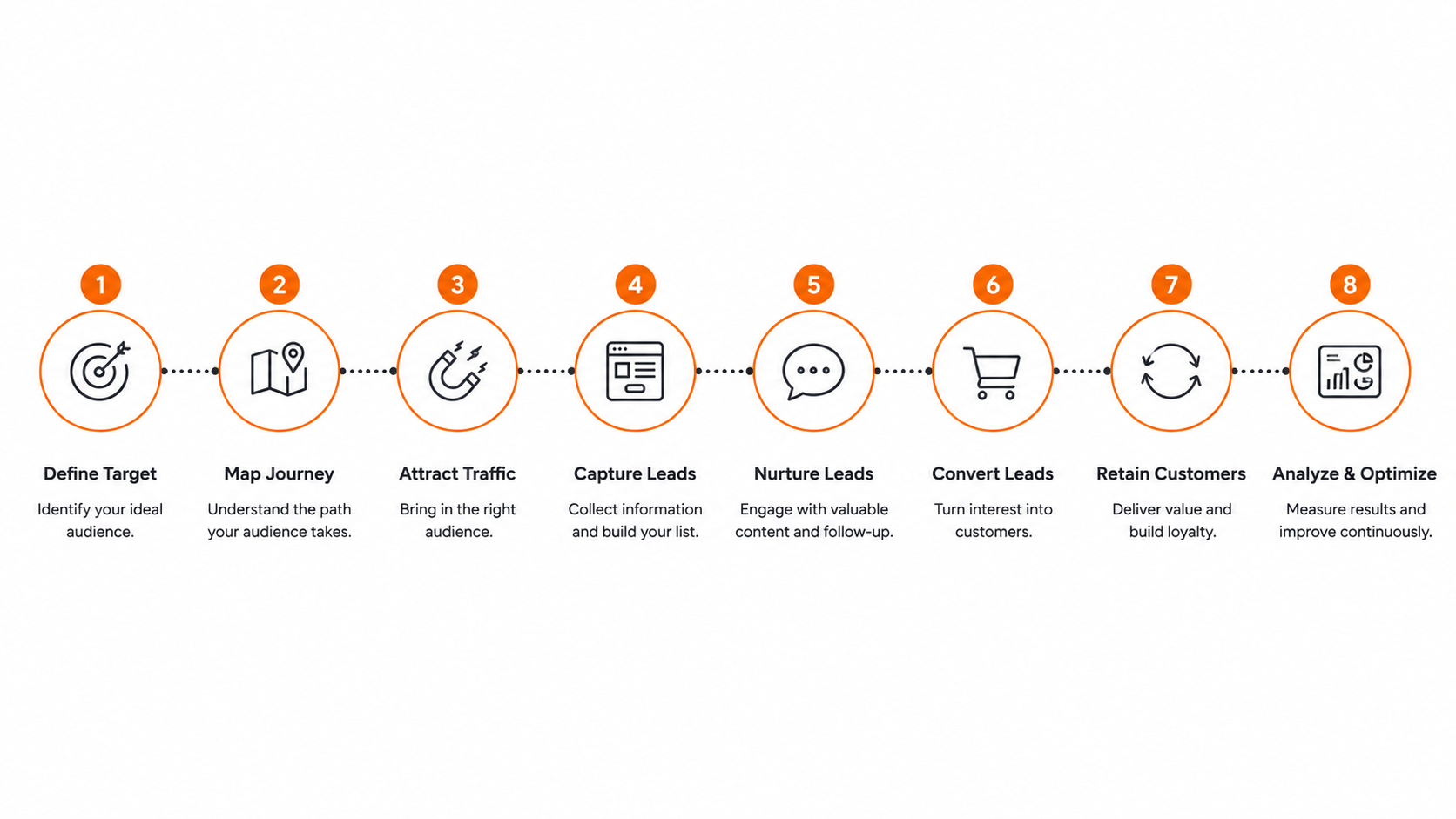
- Define your ideal customer and your one money metric. Who are you for, and what’s the single conversion that matters — a purchase, a booked call, a demo? Everything points at this.
- Map the journey and pick one KPI per stage. Awareness = traffic. Consideration = leads. Decision = conversions. Retention = repeat rate. One number per stage keeps you honest.
- Build the traffic engine (TOFU). A blend works best: organic SEO services for long-term compounding traffic, plus paid performance marketing for speed. SEO builds the asset; ads buy the audience while it grows.
- Create a lead magnet and a capture page. Offer something genuinely useful — a checklist, a free audit, a discount, a calculator — behind a simple form. This is your bridge from anonymous visitor to known lead.
- Set up nurture (MOFU). This is the step that prints money and almost everyone skips. A 4–6 message email or WhatsApp sequence plus retargeting ads keeps you top-of-mind until they’re ready. In India especially, WhatsApp marketing nurture beats email on open rates by a wide margin.
- Build the conversion asset (BOFU). A clean offer page, social proof, and a frictionless way to act — buy now, book a call, start a trial. Cut every unnecessary form field.
- Add the retention loop. Onboarding emails, an upsell, a review request, a referral nudge. This is how one customer becomes three.
- Instrument tracking, then optimise the weakest stage. Install GA4, the Meta pixel, and a basic CRM. Don’t optimise everything at once — find the stage with the steepest drop-off and fix that first. Usually it’s the landing page or the nurture sequence.
What is a good funnel conversion rate? (Real 2026 benchmarks)
Short answer: across all industries, the average overall funnel conversion rate sits around 2–3%, while top performers push past 5% (First Page Sage). For ecommerce specifically, average purchase conversion hovers near 2.9% depending on the category (Statista).
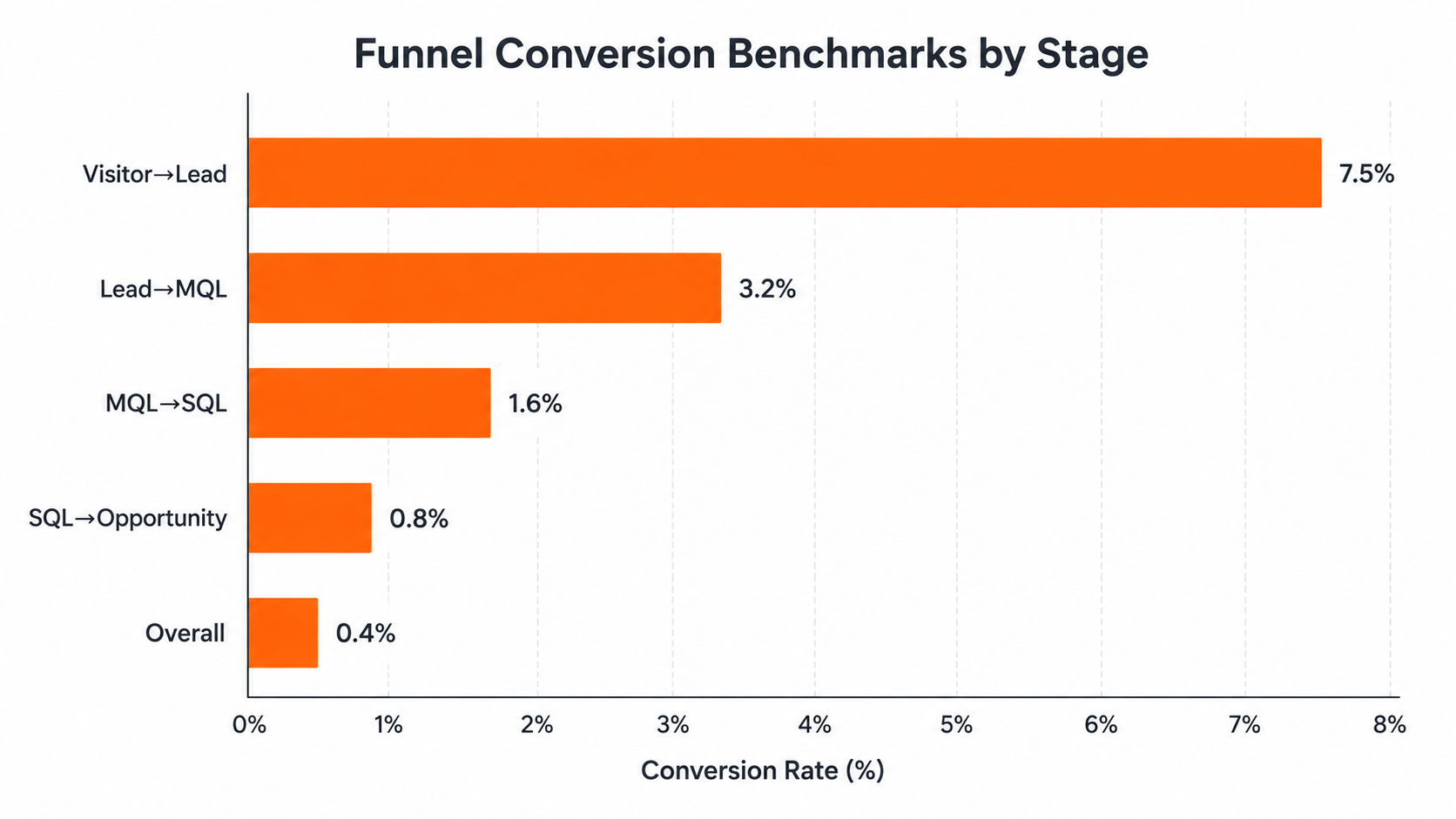
But here’s the thing: one overall number hides the real story. A funnel is a chain of handoffs, and each stage has its own healthy range. Aim for these:
- Visitor → Lead: ~1–5% (depends heavily on traffic quality and landing page relevance)
- Lead → MQL: ~25–35%
- MQL → SQL: ~13–26% (the common bottleneck)
- SQL → Opportunity: ~50–62%
- Overall funnel: 2–3% average, 5%+ is strong, 10%+ is excellent
Source for stage ranges: VWO).
Don’t chase a universal magic number. Compare your funnel to these ranges, find the stage that’s below benchmark, and pour your energy there. A small lift at one weak stage compounds through everything below it. That’s the entire game of conversion rate optimization.
Channels and tools for each funnel stage
You don’t need 40 tools. You need the right few mapped to the right stage. Here’s a practical stack:
Top of funnel (get found):
- SEO + content (blog, YouTube)
- Meta, Google, and LinkedIn ads for reach
- Organic social (Instagram, LinkedIn)
Middle of funnel (capture + nurture):
- Landing pages + opt-in forms
- Email platform (Mailchimp, Brevo, Klaviyo)
- WhatsApp Business API for India-first nurture
- Retargeting pixels (Meta, Google)
Bottom of funnel (convert):
- Booking/scheduling tool (Calendly, or a custom funnel)
- CRM (HubSpot, Zoho — Zoho is popular and affordable in India)
- Reviews and testimonials on the page
Retention (keep + grow):
- Lifecycle email/WhatsApp automation
- Loyalty and referral tools
- Post-purchase surveys (NPS)
Measure everything: Google Analytics 4 (GA4), Google Search Console, and your ad platform dashboards. If you can’t see where people drop, you can’t fix it.
The most common marketing funnel mistakes and myths
We see the same leaks over and over. Avoid these and you’re ahead of most of your competitors.
- Myth: “The funnel is dead.” It isn’t — the journey just became non-linear. The stages are as real as ever; people simply jump between them. Build for re-entry, not a straight line.
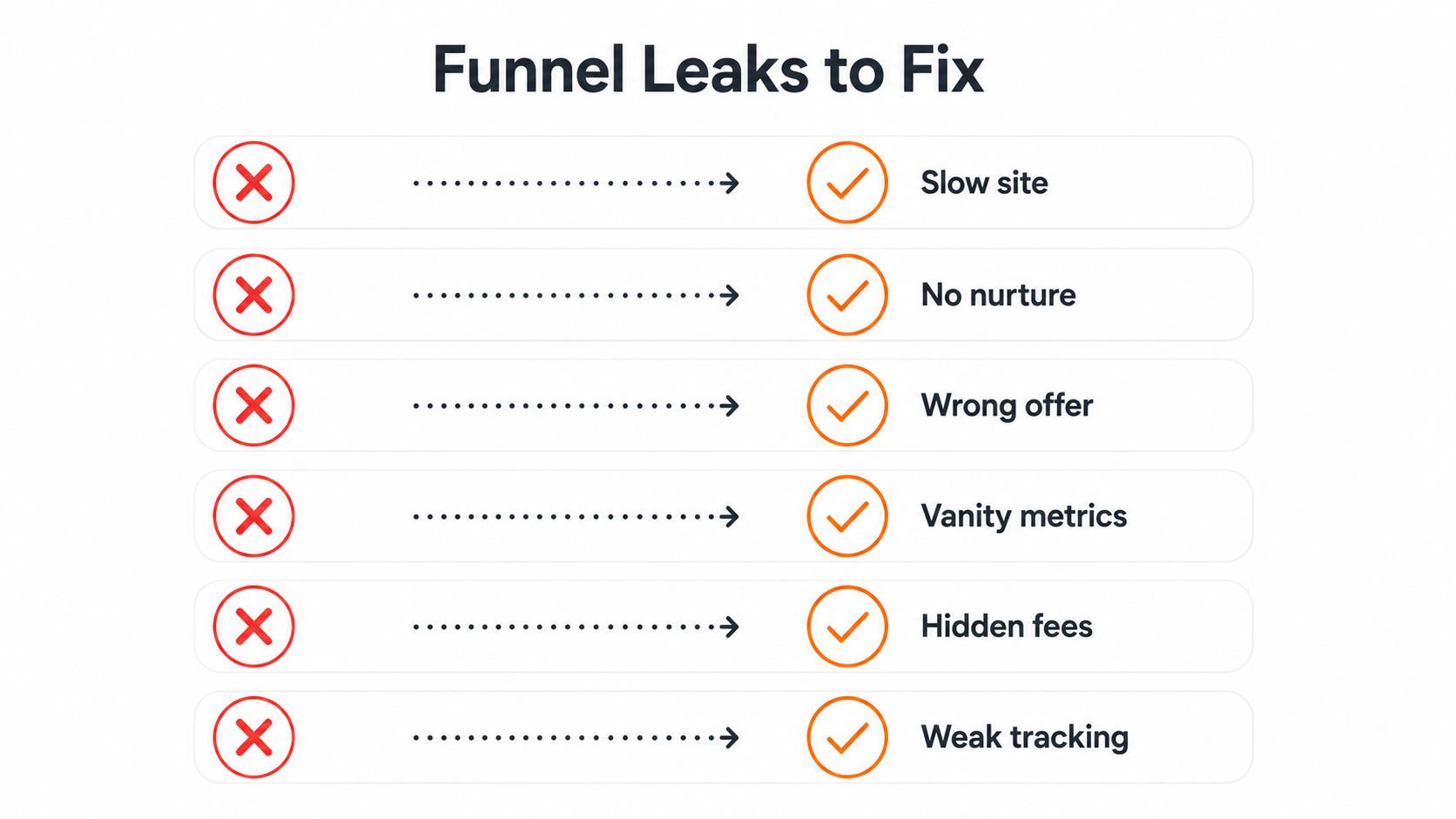
- Mistake: all budget on TOFU, nothing on nurture. Driving traffic to a site with no capture or follow-up is like filling a bucket with a hole in it. Most “my ads don’t work” problems are actually nurture problems.
- Mistake: one offer for everyone. Showing a “Book a Demo” CTA to someone who just discovered you is a stage mismatch. Match the ask to where they are.
- Mistake: chasing vanity metrics. Ten thousand impressions feel great. They don’t pay salaries. Watch cost per lead, conversion rate, and CAC instead.
- Mistake: ignoring mobile and speed. Over half of mobile visitors leave a page that takes more than three seconds to load (Think with Google). In India, where most traffic is mobile, a slow site quietly kills your funnel before it starts.
- Mistake: surprise costs at checkout. For ecommerce, the single biggest reason for abandoned carts is unexpected fees — shipping, taxes, charges — appearing late (Baymard Institute). Show the full price upfront.
- Myth: “More leads = more revenue.” Quality beats quantity. A hundred targeted B2B leads outperform a thousand random ones every time.
Mini case study: how optimisation doubled revenue on the same traffic
Numbers below are illustrative, but the pattern is exactly what we see in real accounts.
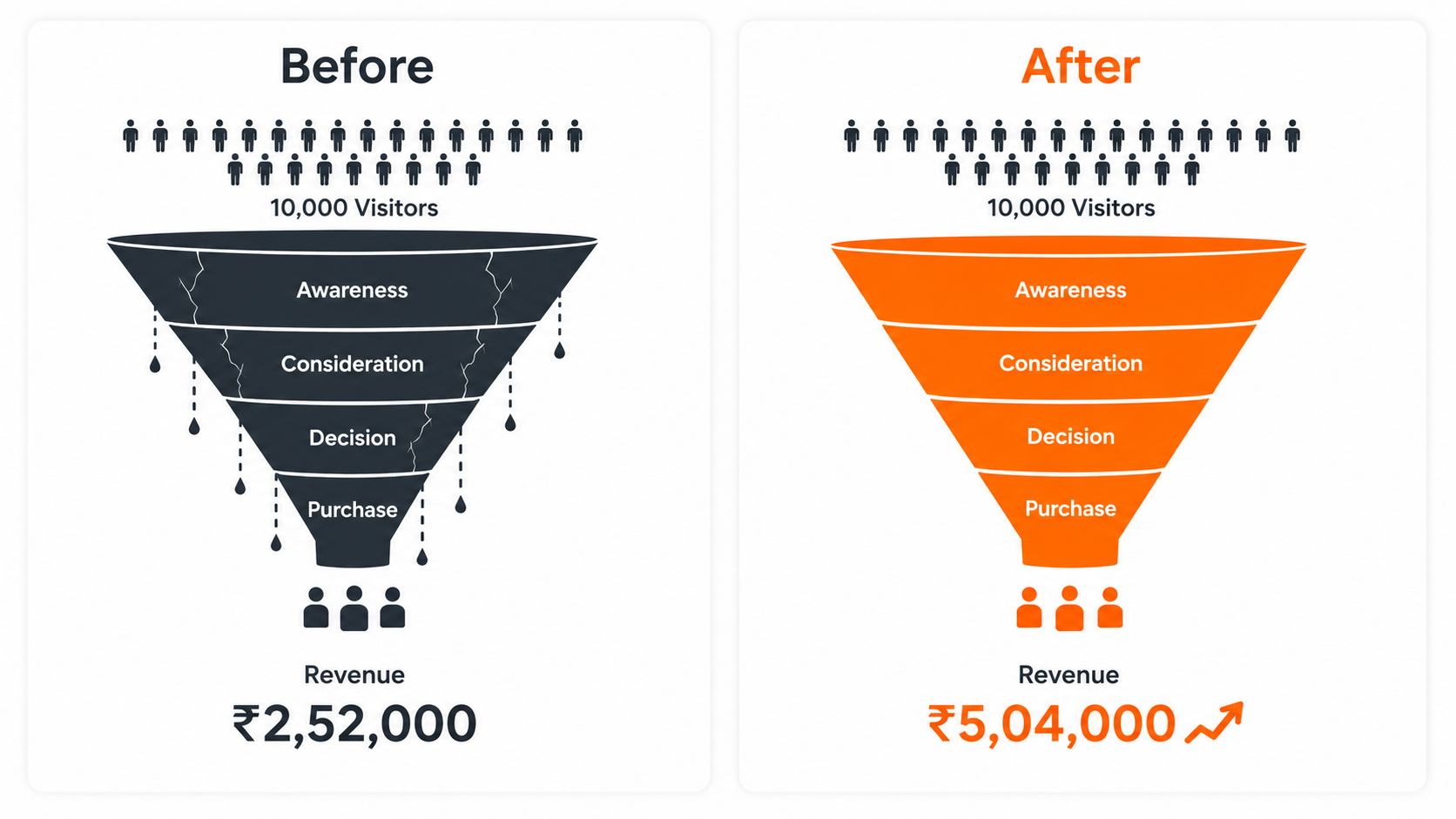
Imagine a D2C skincare brand running Meta ads and SEO. In one month:
- 40,000 visitors land on the site
- Visitor → Lead at 3% = 1,200 leads
- Lead → Customer at 6% = 72 customers
- Average order value: ₹3,500 (~$42)
- Revenue: ₹2,52,000 (~$3,024)
Now the owner stops buying more traffic and instead fixes the funnel. Two changes:
- A faster, cleaner landing page with social proof lifts Visitor → Lead from 3% to 4.5%.
- A WhatsApp nurture sequence plus cart-recovery messages lifts Lead → Customer from 6% to 8%.
Same 40,000 visitors. New result:
- 40,000 × 4.5% = 1,800 leads
- 1,800 × 8% = 144 customers
- 144 × ₹3,500 = ₹5,04,000 (~$6,048)
Revenue doubled — without spending one extra rupee on traffic. That’s the leverage hiding in your funnel. And recovering abandoned carts is a real, documented opportunity: Baymard estimates roughly $260 billion is recoverable in the US and EU alone through better checkout and follow-up (Baymard Institute).
India vs US: how the same funnel flexes by market
The framework is universal. The execution shifts with the audience.
In India, the funnel is mobile-first and messaging-first. WhatsApp is the nurture channel — open rates dwarf email. Buyers are price-sensitive and compare aggressively, often on marketplaces like Flipkart and Meesho before ever visiting your site. Trust signals (reviews, COD, UPI, real phone support) carry the BOFU stage. Speed matters enormously on patchy mobile networks.
In the US, email still does heavy lifting, search intent is strong, and local-service businesses (think roofing, HVAC, dental, plumbing) live and die by reviews and Google Business Profile. Average order values run higher, B2B sales cycles run longer, and people expect polished, fast self-serve experiences.
Same four stages. Different channels, copy, and pace. A good funnel respects where your buyers actually spend their time.
Key Takeaways
- A digital marketing funnel is the structured path from stranger to paying (and repeat) customer, split into awareness, consideration, decision, and retention.
- The journey is non-linear in 2026 — people jump between stages, so build for re-entry with automation, not a rigid straight line.
- The middle of the funnel (nurture) is where most businesses leak leads — and where the fastest wins live.
- Aim for 2–3% overall conversion as a baseline; 5%+ is strong. Benchmark each stage, then fix the weakest one.
- Optimisation beats more traffic. Small lifts at conversion compound and can double revenue on the same visitors.
- Match the offer to the stage, kill site-speed and hidden-fee friction, and track everything in GA4 + a CRM.
Frequently Asked Questions
- What is a digital marketing funnel? It’s the structured journey a prospect takes from first discovering your brand to becoming a paying customer. It organises the customer journey into stages — awareness, consideration, decision, and retention — and pairs the right content and channel with each stage so more people convert instead of dropping off.
- What are the stages of a marketing funnel? The four working stages are Awareness (top of funnel), Consideration (middle), Decision (bottom), and Retention & Advocacy (the post-purchase loop). The first three are often abbreviated TOFU, MOFU, and BOFU.
- What’s the difference between TOFU, MOFU, and BOFU? TOFU (top of funnel) is awareness — educational content to get discovered. MOFU (middle) is consideration — capturing leads and nurturing them. BOFU (bottom) is decision — converting warm leads into customers with offers, demos, and social proof.
- How is a marketing funnel different from a sales funnel? A marketing funnel covers stranger-to-lead (owned by marketing). A sales funnel covers lead-to-customer (owned by sales). They connect at the lead handoff, which is where a lot of revenue is lost if nobody bridges the two.
- How do I build a digital marketing funnel step by step? Define your ideal customer and one money metric, map the journey with a KPI per stage, build a traffic engine (SEO + ads), create a lead magnet and capture page, set up a nurture sequence, build a frictionless conversion page, add a retention loop, then track everything and optimise the weakest stage.
- What is a good funnel conversion rate? Across industries, an overall funnel conversion rate of 2–3% is average, 5%+ is strong, and 10%+ is excellent. More usefully, benchmark each stage: roughly 1–5% visitor-to-lead, 25–35% lead-to-MQL, and 13–26% MQL-to-SQL.
- What are the most common marketing funnel mistakes? Spending all budget on traffic with no nurture, using one offer for every stage, chasing vanity metrics, ignoring mobile site speed, hiding costs until checkout, and not tracking where people drop off.
- What tools do I need to run a digital marketing funnel? At minimum: an SEO/content channel and ad accounts for traffic, landing pages and an email or WhatsApp tool for capture and nurture, a CRM and booking tool for conversion, lifecycle automation for retention, and GA4 plus your ad dashboards to measure it all.
Ready to build a funnel that actually converts?
If your traffic isn’t turning into customers, the fix is almost always the funnel between them — and that’s exactly what we build. Have a quick chat with us on WhatsApp or through our contact page, and we’ll map where your funnel is leaking and how to plug it.
Note: Stage-level conversion ranges and email/cart figures are industry benchmarks; treat exact percentages as directional, since they vary by sector, channel, and source.