
 Chat with Sales & Support


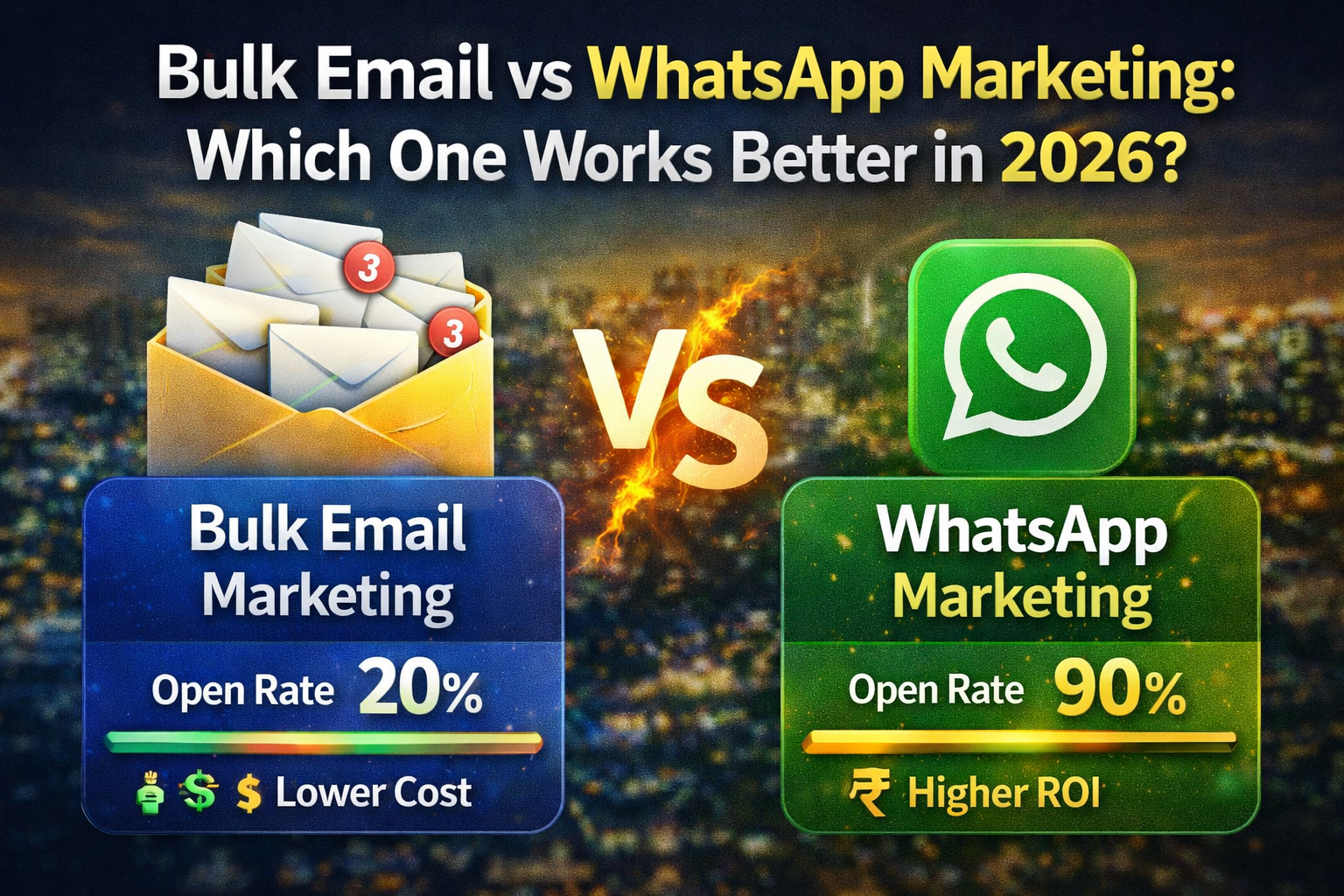
Bulk Email vs WhatsApp Marketing: Which One Works Better in 2026?
Home » Bulk Email vs WhatsApp Marketing: Which One Works Better in 2026?

See How My Agency DIGIBROOD Can Drive Real Growth for Your Business
Digital Marketing – performance-driven strategies to generate high-quality leads and consistent sales.
Website Development – fast, conversion-focused websites built to scale your business online.
WhatsApp & Bulk Marketing – powerful automation tools to reach thousands of customers instantly.
Data & Lead Solutions – verified, targeted databases to boost your outreach and ROI.
We don’t just offer services—we build systems that grow your business.
Introduction: The Great Marketing Debate of 2026
Every business owner, startup founder, and marketing manager in India is facing the same critical question in 2026: should I invest my marketing budget in bulk email marketing or WhatsApp marketing? Both channels have passionate advocates, proven track records, and powerful tools behind them. But the answer is not as simple as choosing one over the other.
Email marketing has been the backbone of digital communication for over two decades. It remains one of the most cost-effective channels for reaching large audiences, nurturing long-term relationships, and delivering detailed content. With modern bulk email marketing software, businesses can send thousands of personalised emails, automate complex sequences, and track performance with granular analytics.
WhatsApp marketing, on the other hand, has exploded in popularity across India, driven by the platform’s 500+ million user base and unmatched engagement rates. With the right whatsapp marketing software, businesses are generating leads, closing sales, and building customer relationships through a channel that delivers 80–95% open rates—numbers that email marketers can only dream of.
So which one actually works better? The honest answer is: it depends on your goals, your audience, and your strategy. In this comprehensive guide, we’ll break down every aspect of the email vs WhatsApp debate—open rates, conversion rates, costs, automation capabilities, legal considerations, and ideal use cases—so you can make an informed decision. Better yet, we’ll show you why the smartest businesses in 2026 are using both channels together in a hybrid strategy that maximises results.
Let’s dive in.
What Is Bulk Email Marketing?
Bulk email marketing is the practice of sending promotional, transactional, or informational emails to a large list of recipients simultaneously. It has been a cornerstone of digital marketing since the early days of the internet, and in 2026, it remains one of the most widely used marketing channels globally.
Modern bulk email campaigns go far beyond simple mass blasts. With professional bulk email marketing software, businesses can create visually rich HTML emails with branded templates and responsive designs, personalise every email with dynamic fields such as recipient name, company, location, and past purchase history, automate complex email sequences including welcome series, lead nurture campaigns, abandoned cart reminders, and re-engagement flows, segment audiences based on demographics, behaviour, engagement level, and funnel stage, and track detailed analytics including open rates, click-through rates, bounce rates, unsubscribes, and conversions.
For businesses focused on long-form content delivery, brand building, and sustained relationship nurturing, a reliable email marketing service remains indispensable.
Common Use Cases for Bulk Email Marketing
- Newsletters and content marketing: Regular email newsletters keep your audience informed, educated, and engaged with your brand over weeks and months.
- Product launches and announcements: Email allows you to send detailed product information, feature breakdowns, pricing tables, and launch offers to your entire customer base.
- E-commerce promotions: Flash sales, seasonal discounts, personalised product recommendations, and abandoned cart recovery emails drive direct revenue.
- B2B lead nurturing: Multi-step email drip campaigns educate prospects, build trust, and move them through long B2B sales cycles.
- Transactional communications: Order confirmations, shipping updates, invoices, password resets, and account notifications.
What Makes a Great Bulk Email Marketing Software?
Not all email tools are created equal. The best bulk email marketing software should offer high deliverability rates with SMTP infrastructure that ensures your emails land in inboxes, not spam folders. It should include advanced personalisation and dynamic content, visual drag-and-drop email builders, robust automation workflows, audience segmentation and list management, real-time analytics and reporting, and integration with CRM, landing page, and e-commerce platforms.
For cold outreach campaigns—reaching prospects who haven’t previously interacted with your brand—a dedicated cold email marketing software is essential. Cold email tools are specifically designed for high-volume outreach with features like email warm-up, domain rotation, reply tracking, and automatic follow-up sequences that keep your sender reputation intact.
What Is WhatsApp Marketing?
WhatsApp marketing is the practice of using WhatsApp as a business communication and marketing channel to send promotional messages, engage with customers in real time, generate and nurture leads, and drive conversions. In India, where WhatsApp is the default messaging platform for over 500 million people, it has become the fastest-growing marketing channel of the decade.
With professional whatsapp marketing software, businesses can send personalised bulk messages to thousands of targeted contacts, set up intelligent auto-replies and chatbot flows that respond to customer enquiries 24/7, build multi-step lead nurture sequences that follow up automatically based on customer behaviour, capture and log leads directly into CRM systems without manual data entry, send rich media including images, videos, PDFs, catalogues, and interactive buttons, and track campaign performance with delivery, read, reply, and conversion analytics.
Common Use Cases for WhatsApp Marketing
- Instant lead generation: Send targeted promotional messages to segmented lists and capture interested replies instantly.
- Flash sales and time-sensitive offers: WhatsApp’s near-instant read rates make it perfect for urgency-driven campaigns.
- Customer support and engagement: Handle customer queries, complaints, and requests through conversational WhatsApp interactions.
- Appointment and booking reminders: Clinics, salons, fitness centres, and service providers use WhatsApp to reduce no-shows.
- Order updates and delivery tracking: E-commerce businesses keep customers informed at every stage of their purchase.
- Community building: WhatsApp groups and broadcast lists create loyal brand communities that drive repeat engagement and referrals.
Bulk Email vs WhatsApp Marketing: The Complete Head-to-Head Comparison
Let’s compare these two channels across every metric that matters to your business:
1. Open Rate and Readability
| Metric | Bulk Email Marketing |
WhatsApp Marketing |
| Average Open Rate | 10–20% | 80–95% |
| Where Messages Land | Inbox (often Promotions tab or Spam) | Personal chat inbox |
| Time to Open | Hours to days | Minutes |
| Message Visibility | Competes with dozens of daily emails | Stands out among personal messages |
WhatsApp dominates open rates because messages appear alongside personal conversations from friends and family. Email, by contrast, competes with dozens of other promotional messages and is frequently filtered into spam or promotions folders that many users never check.
Verdict: WhatsApp wins decisively on open rates and readability.
2. Response Rate and Engagement
|
Metric |
Bulk Email Marketing |
WhatsApp Marketing |
| Average Reply Rate | 1–5% | 20–40% |
| Engagement Type | Click-based (links, buttons) | Conversational (real-time replies) |
| Average Response Time | 24–72 hours | Under 5 minutes |
| Two-Way Communication | Limited | Native and seamless |
WhatsApp’s conversational nature encourages immediate, two-way interaction. When a prospect replies to a WhatsApp message, it opens a direct dialogue that can be guided toward conversion in real time—either manually by your sales team or automatically through whatsapp marketing software chatbot flows.
Verdict: WhatsApp wins on response rate and engagement quality.
3. Cost and ROI
|
Metric |
Bulk Email Marketing |
WhatsApp Marketing |
| Sending Cost per 10,000 Messages | ₹200–₹500 | ₹1,000–₹3,000 |
| Tool / Software Cost | Low to Medium | Medium |
| Cost per Lead (Typical) | ₹50–₹300 | ₹20–₹150 |
| ROI per Campaign | Moderate | High to Very High |
Email marketing is cheaper per message, making it ideal for high-volume campaigns where reach matters more than immediate engagement. However, WhatsApp’s significantly higher conversion rate means your cost per qualified lead is often lower—you spend more per message but convert more of those messages into actual business.
When you use bulk email marketing software for large-scale outreach and whatsapp marketing software for high-intent follow-ups, you optimise both cost and conversion.
Verdict: Email wins on raw cost per message. WhatsApp wins on cost per lead and ROI.
4. Personalisation and Targeting
|
Metric |
Bulk Email Marketing |
WhatsApp Marketing |
| Dynamic Personalisation | High (name, company, behaviour, etc.) | Very High (name, location, context) |
| Segmentation Capabilities | Advanced (tags, lists, behaviour triggers) | Moderate to Advanced (with software) |
| Content Richness | HTML templates, images, embedded video | Text, images, video, PDF, buttons |
| Perceived Personalisation | Medium (feels like marketing) | Very High (feels like personal message) |
Both channels support dynamic personalisation, but WhatsApp messages inherently feel more personal because they arrive in the same inbox as messages from friends and family. This perceived personalisation translates directly into higher trust and engagement.
Verdict: WhatsApp wins on perceived personalisation. Email wins on content richness and segmentation depth.
5. Automation Capabilities
Both channels now offer sophisticated automation, but with different strengths:
Email automation excels at multi-step drip campaigns spanning weeks or months, behaviour-triggered emails based on website visits, purchases, or engagement, A/B testing of subject lines, content, and send times, and complex conditional logic branching in automation workflows.
WhatsApp automation excels at instant auto-replies to inbound messages, conversational chatbot flows that qualify leads through dialogue, real-time lead capture and CRM integration, and time-sensitive follow-up sequences with high completion rates.
Professional email marketing service platforms and whatsapp marketing software both offer powerful automation, but they shine in different contexts.
Verdict: Tie. Both offer advanced automation suited to their channel’s strengths.
6. Legal Compliance and Risk
|
Factor |
Bulk Email Marketing |
WhatsApp Marketing |
| Spam Risk | High (spam filters, blacklisting) | Medium (number bans if misused) |
| Opt-In Requirements | Recommended (CAN-SPAM, GDPR) | Recommended (platform guidelines) |
| Deliverability Challenges | Spam folders, bounces, ISP blocks | Number bans, rate limiting |
| Compliance Complexity | Medium to High | Medium |
Email marketing faces well-established compliance frameworks and spam filtering systems that can block your campaigns if not managed properly. A good cold email marketing software helps manage sender reputation, domain warm-up, and deliverability optimisation.
WhatsApp marketing requires careful adherence to platform guidelines to avoid number bans. Using reputable whatsapp marketing software with built-in compliance features significantly reduces this risk.
Verdict: Both require responsible practices. Email has more established compliance frameworks; WhatsApp has simpler but stricter enforcement.
When Should You Use Email Marketing?
Email marketing is the right choice when your strategy requires:
- Long-form content delivery: Newsletters, blog digests, whitepapers, case studies, and detailed product information are best suited for email’s rich HTML format.
- Long-term lead nurturing: B2B sales cycles that span weeks or months benefit from email’s ability to deliver sequenced, educational content over time.
- Brand building: Consistent, professionally designed email newsletters build brand recognition, authority, and trust over time.
- Large-scale, low-cost outreach: When you need to reach 50,000 or 100,000 contacts and your primary goal is awareness rather than immediate conversion, email’s low per-message cost is hard to beat.
- Cold outreach to new prospects: With proper cold email marketing software, you can run high-volume prospecting campaigns with email warm-up, personalisation, and automated follow-ups.
A professional email marketing service like DIGIBROOD’s provides the infrastructure, tools, and expertise to run effective email campaigns at any scale.
When Should You Use WhatsApp Marketing?
WhatsApp marketing is the right choice when your strategy requires:
- Instant engagement and fast responses: When speed matters—flash sales, limited-time offers, event reminders—WhatsApp’s instant delivery and near-immediate read rates are unbeatable.
- High-conversion lead generation: For campaigns where every lead counts, WhatsApp’s 20–40% reply rates mean more conversations and more opportunities to convert.
- Conversational selling: Products or services that benefit from real-time Q&A, objection handling, and personalised recommendations thrive on WhatsApp.
- Customer support and retention: WhatsApp’s familiar, conversational interface makes it the preferred channel for customer service interactions in India.
- Local and regional campaigns: Reaching customers in specific cities, neighbourhoods, or regions with localised offers and messaging.
DIGIBROOD’s whatsapp marketing software gives you everything you need to launch, automate, and scale WhatsApp campaigns that generate real business results.
The Hybrid Strategy: Why the Smartest Businesses Use Both
Here’s what most businesses get wrong: they treat email and WhatsApp as competing channels and choose one over the other. The businesses generating the best results in 2026 are doing something different—they’re combining both channels into an integrated, multi-touchpoint marketing system.
How the Hybrid Strategy Works
The hybrid approach leverages each channel for what it does best:
- Email delivers the first touchpoint: Send a detailed, professionally designed email with your core message, product information, case studies, or offer details. Email’s rich format is perfect for this kind of in-depth content delivery.
- WhatsApp follows up for engagement: 24–48 hours after the email is sent, a personalised WhatsApp message follows up with a short, conversational prompt. Example: “Hi Priya, did you see the marketing package we emailed yesterday? Happy to answer any questions here!”
- WhatsApp automation handles responses: When the prospect replies, your whatsapp marketing software auto-replies with relevant details, captures the lead in your CRM, and triggers the appropriate follow-up sequence.
- Email nurtures long-term: Leads who engage but don’t convert immediately enter an email nurture sequence with additional value, social proof, and periodic offers over the following weeks.
- WhatsApp closes the deal: When a nurtured lead shows renewed interest (opens multiple emails, clicks links, revisits your website), a WhatsApp message re-engages them for a direct conversation and final conversion.
Real-World Hybrid Campaign Results
Here’s what a typical hybrid campaign looks like in practice for a DIGIBROOD client:
|
Campaign Stage |
Channel | Volume |
Result |
| Initial outreach | Bulk Email | 10,000 sent | 2,000 opened (20%) |
| Detailed engagement | 2,000 opened | 300 clicked (15%) | |
| Follow-up for engagement | 10,000 sent | 1,200 replies (12%) | |
| Lead qualification | WhatsApp Automation | 1,200 replies | 350 qualified leads |
| Conversion | WhatsApp + Sales Team | 350 qualified | 45 paying customers |
By using email for broad reach and detailed content, then WhatsApp for high-engagement follow-up and conversion, this campaign generated 45 paying customers from a single 10,000-contact campaign—a result neither channel could have achieved alone.
This integrated approach is exactly what DIGIBROOD delivers through its combined email marketing service and whatsapp marketing software platform.
Common Mistakes That Kill Email and WhatsApp Campaigns
Even with the right tools, poor execution can destroy your results. Here are the most damaging mistakes and how to avoid them:
Email Marketing Mistakes
- No email warm-up: Sending thousands of emails from a new domain without proper warm-up triggers spam filters and blacklisting. Use cold email marketing software with built-in warm-up features to build sender reputation gradually.
- Generic subject lines: Subject lines like “Special Offer Inside!” get ignored or flagged as spam. Use personalised, curiosity-driven subject lines that reference the recipient’s name, company, or industry.
- No segmentation: Sending the same email to your entire list signals laziness. Segment by industry, location, engagement level, and funnel stage.
- Missing follow-up sequences: A single email rarely converts. Set up automated 3–5 email follow-up sequences that provide additional value with each touchpoint.
- Ignoring analytics: If you’re not tracking open rates, click rates, bounces, and conversions, you cannot improve.
WhatsApp Marketing Mistakes
- Mass spamming without targeting: Sending generic promotional messages to unsegmented lists gets you blocked and banned. Always target based on location, industry, and interest.
- No automation setup: If someone replies “Interested” and doesn’t get an instant response because your team is asleep or busy, you’ve lost a hot lead. Automation is non-negotiable.
- Overly aggressive selling: WhatsApp is a personal space. Messages that feel like spam advertisements destroy trust. Lead with value, not hard sells.
- Poor data quality: Sending to invalid, outdated, or irrelevant numbers wastes your budget and increases your ban risk.
- No follow-up strategy: One message is not enough. Set up 3–5 message follow-up sequences over 1–2 weeks for maximum conversion.
Best Tools for Email and WhatsApp Marketing in 2026
For Bulk Email Marketing
Your email marketing stack should include:
- Bulk email marketing software: A platform with SMTP infrastructure, high deliverability, template builders, automation, and analytics. DIGIBROOD’s bulk email marketing software is purpose-built for Indian businesses running high-volume campaigns.
- Cold email marketing software: For prospecting and outreach to new audiences, use tools with email warm-up, domain rotation, and reply tracking. DIGIBROOD’s cold email marketing software handles all of this out of the box.
- Email marketing service: A complete service that combines software, strategy, and support. DIGIBROOD’s email marketing service provides done-for-you campaign management, template design, list management, and performance optimisation.
For WhatsApp Marketing
Your WhatsApp marketing stack should include:
- WhatsApp marketing software: A platform for bulk messaging, automation, chatbots, and CRM integration. DIGIBROOD’s whatsapp marketing software is the leading solution for Indian businesses.
- Verified contact database: High-quality, targeted data segmented by location, industry, and interest.
- CRM integration: Seamless connection between WhatsApp conversations and your lead management system.
For the Hybrid Strategy
The ideal setup combines both stacks into a unified platform. DIGIBROOD provides a complete ecosystem including bulk email marketing software, cold email marketing software, whatsapp marketing software, verified databases, CRM integration, and expert campaign management—all under one roof.
Final Verdict: Which One Works Better?
Let’s settle this with a clear summary:
|
If You Want… |
Best Channel |
Why |
| Lowest cost per message | SMTP-based sending is extremely affordable at scale | |
| Highest open rates | 80–95% vs email’s 10–20% | |
| Fastest response times | Replies within minutes, not hours or days | |
| Best long-term nurturing | Multi-step drip campaigns over weeks/months | |
| Highest conversion rate | Conversational engagement drives faster decisions | |
| Best ROI overall | Both (Hybrid) | Email for reach + WhatsApp for conversion |
| Cold prospecting at scale | Cold email software handles high-volume outreach | |
| Customer support | Conversational, real-time, and preferred by Indian consumers |
The bottom line: There is no single winner. Email marketing and WhatsApp marketing are not competing channels—they are complementary ones. The businesses generating the best results in 2026 are those using bulk email marketing software for broad reach and detailed nurturing, and whatsapp marketing software for high-engagement lead generation and conversational conversion.
The smartest strategy is not either/or—it’s both.
Frequently Asked Questions
What is the difference between bulk email marketing software and cold email marketing software?
Bulk email marketing software is designed for sending promotional emails to large opt-in lists—newsletters, offers, announcements, and nurture campaigns. Cold email marketing software is specifically built for outbound prospecting to contacts who haven’t previously engaged with your brand. Cold email tools include features like email warm-up, domain rotation, and reply tracking that are essential for maintaining deliverability during outreach campaigns.
Can I use WhatsApp marketing for B2B lead generation?
Absolutely. WhatsApp is highly effective for B2B lead generation in India, where business owners and decision-makers actively use WhatsApp for professional communication. Use targeted databases and personalised messaging through your whatsapp marketing software to reach prospects in any industry.
What is an email marketing service?
An email marketing service is a comprehensive solution that goes beyond just software. It includes campaign strategy, email template design, list management, deliverability optimisation, analytics, and ongoing support—essentially a done-for-you approach to email marketing.
Will my WhatsApp number get banned?
If you use reputable whatsapp marketing software with compliance features, send relevant and personalised content, avoid aggressive spamming, and follow platform guidelines, your risk of being banned is minimal.
How do I get started with the hybrid strategy?
The easiest way is to partner with a provider that offers both channels. DIGIBROOD provides integrated bulk email marketing software, cold email marketing software, whatsapp marketing software, verified databases, and expert campaign management—giving you everything you need to launch a powerful hybrid strategy from day one.
Conclusion: Stop Choosing—Start Combining
The debate between email marketing and WhatsApp marketing is a false choice. In 2026, the most successful Indian businesses are not picking one channel over the other—they’re building integrated marketing systems that leverage the unique strengths of each.
Use email for what it does best: large-scale outreach, rich content delivery, long-term nurturing, brand building, and cold prospecting. Use WhatsApp for what it does best: instant engagement, high open rates, conversational selling, real-time support, and fast conversion.
Together, they create a marketing machine that is greater than the sum of its parts.
Ready to build your integrated marketing system? DIGIBROOD gives you everything under one roof:
- Bulk Email Marketing Software — for high-volume, high-deliverability email campaigns
- Cold Email Marketing Software — for outbound prospecting and cold outreach at scale
- Email Marketing Service — for done-for-you campaign strategy and management
- WhatsApp Marketing Software — for bulk messaging, automation, and conversational lead generation
- Verified databases, CRM integration, and expert support
Visit digibrood.com or contact the DIGIBROOD team directly to get started today.